 Serengeti Blinds
The Range · Motorisation
One button, every blind in the house.
On a Serengeti Estate home with double-volume glass and wide stacking doors, motorisation stops being a luxury add-on and starts being the only practical way to run your blinds.
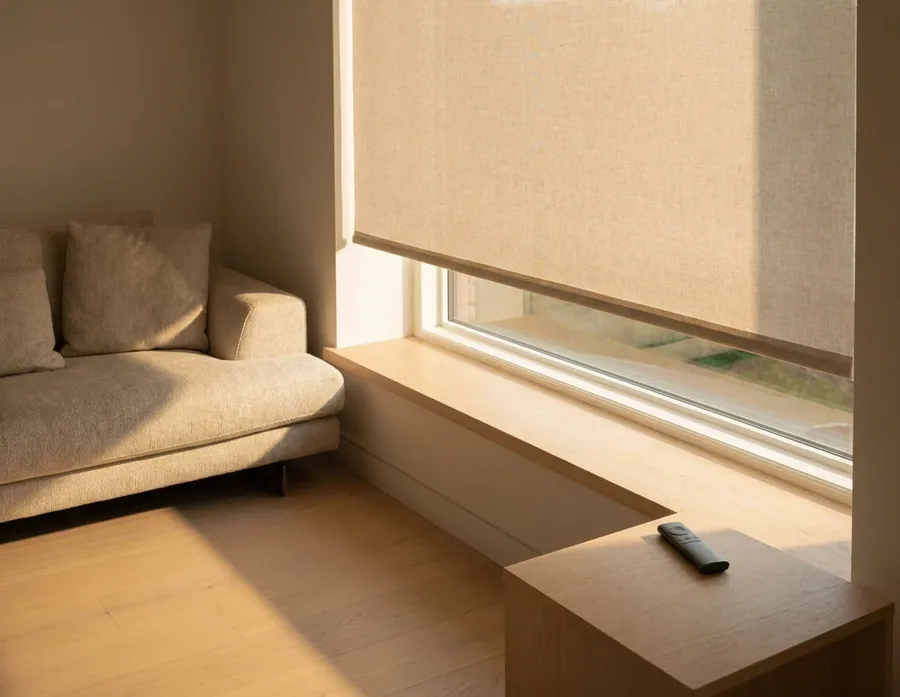
Every blind on the range can be motorised — a quiet tubular motor sits inside the roll and takes over from a chain or cord entirely. It's the upgrade most Serengeti Estate homeowners end up choosing on at least a few windows, because so much of the glazing here is wide, high or above a stair void where a chain simply can't reach.
Power: battery or wired
Rechargeable battery motors need no wiring and suit most interior blinds — they're the easy retrofit option, charged every few months. For heavier systems, exterior products and new-build rooms, a wired 220V motor is the better long-term choice: no charging, no interruption, built in at the electrical planning stage. We'll advise which makes sense per room at your measure.
Control that suits how you actually live
- Remote handset — one remote, every blind on that channel, no app required.
- App control — close the west-facing blinds from the office, or the golf cart, without a second thought.
- Schedules — bedroom blinds ease open at sunrise, the fairway-facing lounge blinds drop automatically before the worst of the afternoon sun.
- Sun and wind sensors — automatic shading on hot elevations, and automatic retraction on exterior products before a highveld storm hits.
Where it's essentially required
Spans too wide or heavy for a chain to comfortably manage, blinds above stair voids and double-volume glass, concealed ceiling-recess systems, external venetians, awnings and zip screens, and any wall of glass where you'd rather press one button than walk down a row of six blinds by hand.
Safe, and honestly, quieter
No dangling chain or cord makes motorisation the most child-safe way to operate a blind — there's nothing to reach for. Quality motors run quiet, though not silent, and carry a multi-year guarantee. If you go the battery route, expect a periodic charge; we'll set that expectation clearly at quote stage rather than let it be a surprise.
What motorisation costs
Motorisation has no price of its own, because what you buy is a product with a motor in it. Across the range fitted here, motorised shading runs roughly R2,500 to R7,500 per square metre installed: a motorised roller blind at R2,500 to R3,800, a motorised external venetian at R4,500 to R6,500, and a motorised fold-arm awning at R5,500 to R7,500 per square metre of projection.
Small openings are charged at a minimum whatever drives them, and a wired motor planned into a new estate build is a different job from a battery motor retrofitted into a finished room. Which one applies, and what each opening comes to, is settled at the free measure and put in writing.
Where We Fit